
 Services
  Technologies
  About
About Success




What is Amazon Bedrock? Foundation Models, Pricing, and How It Works (2026 Guide)
Share article


Table of Contents
Amazon Bedrock is the AWS service that gives you API access to foundation models from Anthropic, Amazon, Meta, Mistral AI, OpenAI and a dozen other providers, all through a single endpoint inside your own AWS account. You pick a model, send a prompt, and pay per token. AWS handles the GPUs, the scaling, and the uptime.
The definition is the easy part. What follows is where the money and the architecture decisions live, starting with which of the 60-plus available models suits your workload and why the first invoice rarely matches the pricing page.
What is Amazon Bedrock?
Amazon Bedrock is a serverless, fully managed service for building generative AI applications. Requests run inside the AWS perimeter, billing lands on your existing AWS account, and access is controlled by the same IAM policies and KMS keys you already use for Amazon S3 or Amazon RDS.
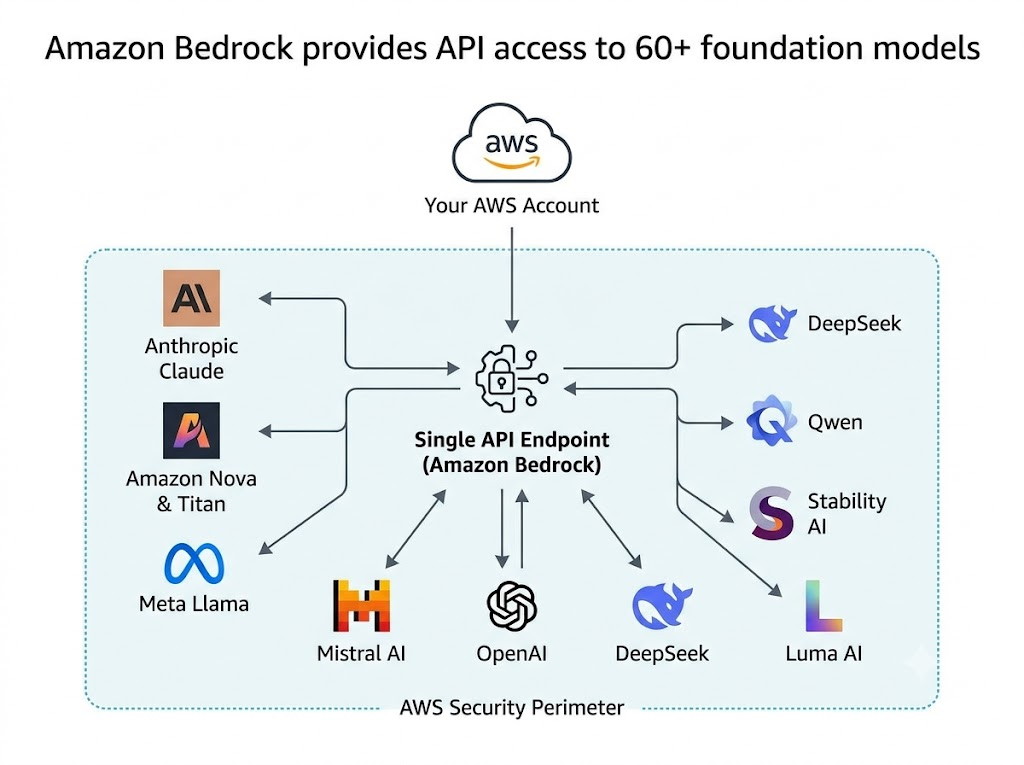
AWS states that Bedrock never stores your data or uses it to train models, with encryption applied both in transit and at rest. For banks, insurers, hospitals, and any company operating under Vietnam’s data protection rules, that posture is usually the first reason Bedrock lands on the shortlist ahead of a public chatbot API.
Bedrock absorbs five things your team would otherwise build and operate:
- GPU provisioning, capacity planning, and cluster maintenance
- A separate contract, invoice, and API integration for every model vendor
- Vector database setup and tuning for retrieval workloads
- Content filtering and PII redaction built from scratch
- Model swapping, which becomes a configuration change instead of a rewrite
You accept AWS as an intermediary between your application and the model. In exchange you get one bill, one security boundary, and one API surface. Most AWS-native teams take that deal without much debate.
The Foundation Models Available on Amazon Bedrock
The catalogue has grown from a handful of models in 2023 to well over 60 text models, plus embedding, image, video, and speech models, from roughly 18 providers as of mid 2026.
Picking one comes down to a narrow question. Which is the cheapest model that still clears your quality bar on the specific task in front of you?
|
Provider |
Representative models |
Where teams usually put them |
| Anthropic | Claude Opus, Sonnet, Haiku | Reasoning, long documents, agent workflows |
| Amazon | Nova Micro, Lite, Pro, Premier, and Titan | High-volume classification, routing, embeddings |
| Meta | Llama 4, Llama 3.3 | Open-weight deployments, fine-tuning |
| Mistral AI | Mistral Large 3, Ministral, Devstral | Cost-sensitive European and multilingual work |
| OpenAI | GPT-5.5, GPT-5.4, gpt-oss | Frontier reasoning inside an AWS account |
| DeepSeek, Qwen, Z AI, Moonshot | DeepSeek v3.2, Qwen3, GLM 5, Kimi K2.5 | Cheap high-volume inference, coding tasks |
| Stability AI, Luma AI, TwelveLabs | Stable Image, Marengo, Pegasus | Image editing, video search and description |
Anthropic Claude on Bedrock
Claude is the most requested family in the enterprise projects we scope, mostly for how it handles long documents and structured output. AWS publishes the full Claude on Bedrock rate card, including prompt caching rates that cut repeated-input costs sharply for chatbots and document assistants.
Amazon Nova and Titan
Amazon’s own models sit at the bottom of the price range and handle a surprising share of production work. Classification, intent routing, data extraction, and summarisation of short text rarely need a frontier model. Routing those calls to Nova Micro or Nova Lite instead of a frontier model tends to cut that slice of the bill by an order of magnitude.
Open-Weight Models
Meta Llama, Mistral, Qwen, and the gpt-oss family are available as managed endpoints, which means you get open-weight economics without running the infrastructure. Bedrock also supports Custom Model Import, so a model you fine-tuned elsewhere can be hosted on Bedrock and billed per Custom Model Unit per minute.
Frontier and Specialist Models
GPT-5.5 arrived on Bedrock in April 2026 at $5.50 per million input tokens and $33.00 per million output tokens in US East (Ohio). At the other end, GLM 4.7 Flash runs at $0.07 input and $0.40 output. That is a 78x spread on input tokens between two models that can both summarise a support ticket. Model choice moves the bill further than anything else you will tune.
>>> Read more: Why Businesses Need Amazon Bedrock Consulting in Vietnam
How Amazon Bedrock Works
Six layers sit on top of the model endpoint. Most teams use the first one on day one and add the rest as the application grows past its prototype.
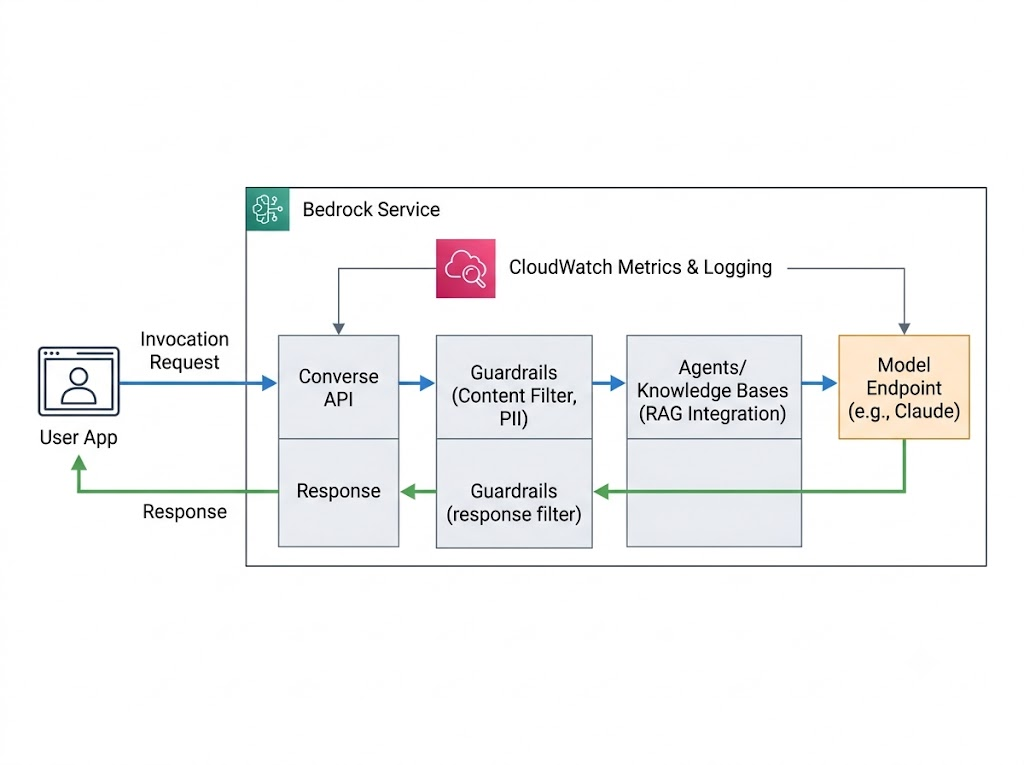
A Single API Across Every Model
The Converse API accepts the same request shape for every supported model, which is what makes swapping models a configuration change. Streaming, tool use, and system prompts work consistently across providers. Cross-region inference routes traffic across AWS regions during traffic spikes without charging you extra for the routing.
Knowledge Bases for Retrieval
Amazon Bedrock Knowledge Bases handles retrieval augmented generation end to end. The managed version, generally available since June 2026, ships with six native connectors covering Amazon S3, SharePoint, Confluence, Google Drive, OneDrive, and a web crawler, plus automatic syncing and managed vector storage.
Vector storage is the line item that catches people out. The default backing store has historically been Amazon OpenSearch Serverless, which carries a two-unit minimum that works out to several hundred US dollars a month even at zero query traffic. Amazon S3 Vectors offers up to 90% lower vector storage cost and has become the sensible default for new knowledge bases.
AgentCore for Production Agents
Amazon Bedrock AgentCore is the agent platform layer, covering runtime, memory, identity, gateway, browser, code interpreter, observability, policy, and evaluations. It works with LangGraph, CrewAI, LlamaIndex, Strands Agents, and the OpenAI Agents SDK, and it supports both MCP and the Agent-to-Agent protocol.
AgentCore is available in fifteen AWS regions, including Singapore, Tokyo, Sydney, and Mumbai.
Guardrails for Safety and Compliance
Amazon Bedrock Guardrails applies policy at the inference boundary. Six safeguard types are available: content filters, denied topics, sensitive information filters, word filters, contextual grounding checks, and Automated Reasoning checks. AWS reports that Guardrails blocks up to 88% of harmful content, and that Automated Reasoning checks validate responses against a formal policy with up to 99% accuracy.
The ApplyGuardrail API works with models hosted outside Bedrock too, which lets one policy layer cover a mixed estate.
Model Evaluation
Automated scoring is free. Human evaluation costs $0.21 per completed task, and LLM-as-a-judge evaluation bills the judge model’s tokens at standard on-demand rates. Building an evaluation set before shipping is the difference between knowing a model swap cost you 2% quality and guessing.
Fine-Tuning and Customisation
Bedrock supports fine-tuning, continued pretraining, model distillation, and reinforcement fine-tuning. Custom text models require Provisioned Throughput for inference, and custom model storage runs $1.95 per model per month.
>>> Read more: How to Implement AI Agents on AWS in 2026
Amazon Bedrock Pricing in 2026
Token rates are the part everyone budgets for. The rest of the bill comes from vector stores, guardrail filters, agent loops, and retries, which is why the first invoice is usually the surprising one.

How Token Billing Works
You pay separately for input tokens and output tokens, at a rate set by the model and the region. Output usually costs three to six times the input rate. Image models bill per image, video models bill per second or per minute, and embedding models bill input tokens only. Regional pricing varies, with Asia Pacific and Europe running roughly 15% to 25% above US East for the same model.
Service Tiers: Standard, Priority, Flex, and Batch
AWS now exposes four service tiers that trade latency against price on the same underlying model.
|
Tier |
Price relative to Standard |
Best suited to |
| Priority | 75% premium | Latency-sensitive user-facing traffic |
| Standard | Baseline | Interactive applications, default choice |
| Flex | 50% discount | Background jobs that tolerate slower responses |
| Batch | 50% discount | Bulk jobs delivered to S3, up to 24 hour turnaround |
Nightly enrichment, bulk classification, historical backfills, and content generation pipelines all belong in Batch or Flex. Nothing about the model or the prompt changes, which makes this the least disruptive saving on the list.
Provisioned Throughput and Reserved Capacity
Provisioned Throughput reserves model units at a fixed hourly rate, with commitment terms of one month or six months. Six-month terms carry the lower hourly rate. The economics work like Reserved Instances, so the break-even point sits somewhere around 80% sustained utilisation. Below that, on-demand is cheaper.
Feature Charges Beyond Inference
These line items appear on the bill separately from token spend.
|
Feature |
Published rate |
| Guardrails content filters and denied topics | $0.15 per 1,000 text units |
| Guardrails sensitive information filters | $0.10 per 1,000 text units |
| Guardrails contextual grounding checks | $0.10 per 1,000 text units |
| Guardrails Automated Reasoning checks | $0.17 per 1,000 text units per policy |
| Guardrails word filters and regex filters | Free |
| Bedrock Data Automation, standard document output | $0.010 per page |
| Bedrock Data Automation, video standard output | $0.050 per minute |
| Intelligent Prompt Routing | $1.00 per 1,000 requests |
| Simple Prompt Optimizer | $0.03 per 1,000 tokens |
| Human model evaluation | $0.21 per task |
A text unit covers up to 1,000 characters, and inputs longer than that are billed as multiple units. Full current rates live on the Amazon Bedrock pricing page, which changes often enough that any figure in a blog post deserves verification before it goes into a budget.
Where Bedrock Bills Usually Go Wrong
Four patterns account for most of the overruns we find when auditing a Bedrock account:
- Agent token amplification: An agent that reasons across several steps can consume five to ten times the tokens visible in the user-facing conversation.
- Idle vector stores: A knowledge base with a provisioned OpenSearch collection bills every hour whether anyone queries it or not.
- Default model selection: Routing simple extraction tasks to a frontier model when a small model would score identically.
- Retries and experimentation: Failed calls, prompt iterations, and evaluation runs all bills at full rate during development.
Intelligent Prompt Routing addresses the third pattern directly by routing simple prompts to smaller models within the same family, which AWS says can cut costs by up to 30% without a measurable accuracy loss.
>>> Read more: What Is CUDOS Dashboard Setup Consulting and When Does Your Business Need It?
Amazon Bedrock Compared With Direct APIs and Self-Hosting

There are three ways to get a foundation model into production, and the right one depends mostly on the rest of your stack.
|
Factor |
Amazon Bedrock | Direct provider API |
Self-hosted on AWS |
| Time to first call | Minutes | Minutes | Days to weeks |
| Day-zero access to new models | Usually a short lag | Immediate | Depends on weights release |
| Billing | One AWS invoice | Separate per vendor | Compute hours |
| Data boundary | Inside your AWS account | Vendor infrastructure | Fully yours |
| Identity and access control | IAM and KMS | Vendor API keys | Yours to build |
| Economics at low volume | Strong | Strong | Poor |
| Economics at very high volume | Good with reserved capacity | Moderate | Best above high utilisation |
When Bedrock Fits Best
Bedrock is the natural choice when your stack already runs on AWS, when procurement or compliance requires a single vendor relationship, when you expect to compare several models against the same workload, or when data residency inside an AWS region is a contractual requirement.
When Another Path Fits Better
A direct provider API makes sense when you need a model the day it launches and the workload has no residency constraint. Self-hosting earns its keep when a single model runs at high, steady utilisation and your team already operates GPU infrastructure, since the ops overhead only amortises at scale.
How to Get Started With Amazon Bedrock
The first workload can be live in an afternoon. Production readiness takes longer, and the order of these steps matters more than it looks.
- Enable model access: In the Bedrock console, request access to the specific models you plan to use. Access is granted per model, per region.
- Choose a region: Singapore, Tokyo, Jakarta, Sydney, and Mumbai are the closest options for Vietnamese workloads. Regional choice affects latency, price, and which models are available.
- Test in the playground: Run your real prompts against three or four candidate models before writing any code. Price differences of 50x are common between models that score similarly on a narrow task.
- Build an evaluation set: Twenty to fifty representative prompts with expected outputs. This becomes the thing you measure every future change against.
- Attach a guardrail: Configure content filters and sensitive information filters before the application touches real users.
- Turn on invocation logging and cost allocation tags: Logging to CloudWatch or S3 gives you the audit trail. Tags give you the per-team cost breakdown.
- Move what you can to Batch or Flex: Any job that tolerates delay belongs there from day one.
The AWS Bedrock documentation covers each step in detail, and the Bedrock FAQs answer most of the quota and regional questions that come up in week one.
>>> Read more: How to Build a Generative AI PoC on AWS with Renova Cloud
What Amazon Bedrock Means for Businesses in Vietnam
AWS research found that 18% of Vietnamese businesses had adopted AI, while 74% remained focused on basic applications. Most of that 74% is stuck in the gap between a working pilot and a production system. That gap is usually about architecture, governance, and who owns the monthly bill.
Bedrock helps because it puts the model inside infrastructure your team already understands. The IAM policies, VPC design, logging, and tagging conventions that govern your existing AWS workloads extend to your AI workloads without a parallel security review. For regulated industries in Vietnam, that continuity is often what gets a project through security review in weeks instead of quarters.
>>> Read more: Renova Cloud Accelerates Enterprise AI as Anthropic Authorized Reseller in Vietnam
Build on Amazon Bedrock With Renova Cloud
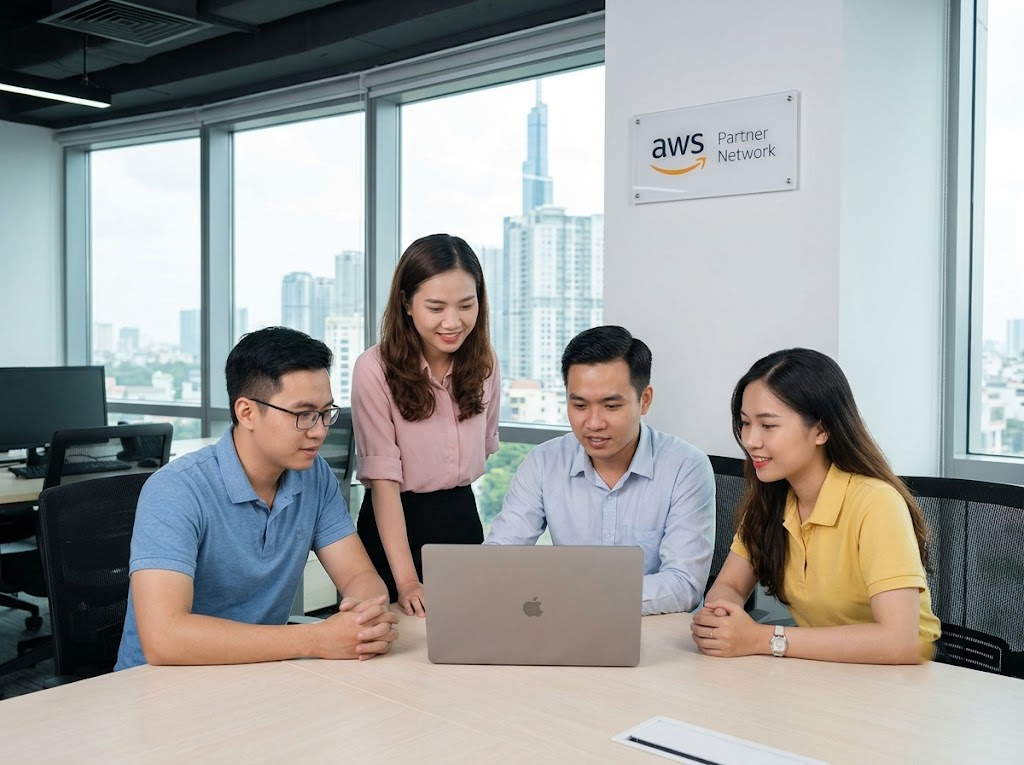
Renova Cloud is an AWS Premier Tier Partner and three-time AWS Partner of the Year for Vietnam, with the AWS AI Services Competency and an authorised Anthropic reseller agreement covering Claude for enterprise. Our team has taken Bedrock workloads from proof of concept to production across finance, manufacturing, retail, and logistics, working from offices in Ho Chi Minh City.
We help with model selection against your own evaluation data, retrieval architecture that keeps vector storage costs sensible, Guardrails and governance design that satisfies your compliance team, and FinOps practices that keep the monthly bill predictable as usage grows. Our Generative AI on AWS practice runs the whole path, from a two-week PoC through to a supported production platform.
Talk to our AWS and AI specialists about what Amazon Bedrock could do for your business.