
 Services
  Technologies
  About
About Success




What is RAG? Retrieval-Augmented Generation Explained with AWS Architecture
Share article


Table of Contents
RAG stands for retrieval-augmented generation. It is a design pattern where an application searches your own documents first, then hands the relevant passages to a large language model as context, so the answer comes from your data instead of the model’s training set.
It solves two problems at the same time. Models go stale the moment training ends, and no model has ever seen your contracts, tickets, or product manuals. RAG closes both gaps without retraining anything.
What Is RAG?

A RAG system turns a user question into a grounded answer through a repeatable pipeline. The pipeline has three stages that run in order, and each stage depends on the one before it.
|
Stage |
What happens |
Technology used |
| Indexing | Documents are cleaned, split into chunks, converted to vectors, and stored | Embedding model, vector database |
| Retrieval | The user question is matched to the most relevant chunks | Similarity search, re-ranking |
| Generation | The model writes an answer using the retrieved chunks as context | Large language model |
Indexing runs once and then refreshes as your data changes. Retrieval and generation run on every question. The final answer quality reflects how well all three stages perform together.
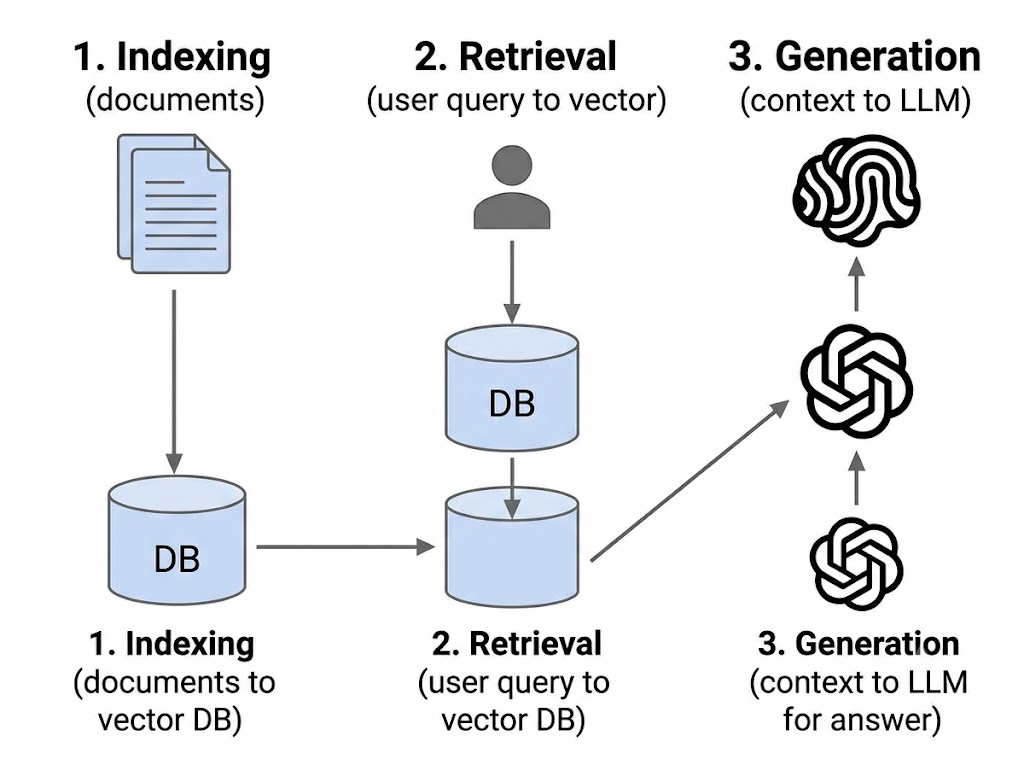
The live request flow looks like this:
- A user submits a question to the application.
- The system converts the question into a vector using the same embedding model used during indexing.
- The vector store returns the chunks most similar to the question.
- Those chunks are added to the prompt alongside the original question.
- The language model generates a response that stays inside the provided context.
The model never reads your entire knowledge base at once. It reads only the few chunks that scored highest for that specific question. This keeps the context window focused and the answer specific to the user’s intent.
RAG earns trust because every answer can point back to a source. When a system shows the documents it used, users can verify the facts and place trust in the evidence the model cites. This citation ability is one reason regulated industries such as finance, healthcare, and insurance adopt RAG for customer facing work. RAG also shortens the path from a new document to a usable answer because there is no model training step in the loop.
How Retrieval-Augmented Generation Works
Each of the four stages has its own failure modes and its own tuning knobs. Teams that treat RAG as a single black box usually discover this the hard way, somewhere around the third round of complaints about wrong answers.
Stage One: Ingest and Chunk the Source Data
Documents get split into passages small enough to fit a retrieval budget and large enough to carry meaning. Chunking sets the ceiling for everything downstream. A passage split mid-argument retrieves badly no matter how good the embedding model or the reranker is.
|
Chunking strategy |
Context preserved | Complexity |
Suits |
| Fixed-size | Moderate | Low | FAQs, short records |
| Overlapping windows | High | Medium | Technical and legal documents |
| Semantic windowing | Very high | High | Research papers, long narratives |
| Hierarchical | Very high | Very high | Structured manuals, policy sets |
Splitting on headings and section boundaries beats splitting on character counts for most business documents. A common refinement is to embed small child chunks for precision and return the larger parent passage for context.
Stage Two: Embed and Index
An embedding model converts each chunk into a vector, usually several hundred to a few thousand dimensions wide. Those vectors go into a store that supports similarity search. Domain-heavy vocabulary in legal, medical, or engineering corpora is where general-purpose embedding models start to underperform, and where testing two or three candidates pays for itself.
Stage Three: Retrieve at Query Time
The user’s question becomes a vector, and the store returns the nearest matches. Pure vector search misses exact-match cases such as product codes and error numbers, which is why hybrid retrieval combining vector similarity with keyword search has become standard practice.
Stage Four: Augment the Prompt and Generate
The retrieved passages are inserted into the prompt with instructions telling the model to answer only from that context and to cite which passage supports each claim. Contextual grounding checks can then verify that the answer follows from the retrieved text before it reaches the user.
>>> Read more: Why Businesses Need Amazon Bedrock Consulting in Vietnam
Why Teams Choose RAG Over Fine-Tuning
Organizations often weigh RAG against fine-tuning when they want a model to reflect their business. The two methods solve different problems, and the table below maps the differences.
|
Dimension |
RAG |
Fine-tuning |
| Goal | Ground responses in fresh data | Specialize the model’s behavior |
| Data needed | A document corpus | A labeled training set |
| Maintenance | Add or update documents | Retrain the model |
| Best for | Fast-changing knowledge | Fixed style or task format |
| Cost profile | Pay per query and storage | Upfront training plus upkeep |
RAG stores your knowledge in a system you control and update at any time. Fine-tuning writes knowledge directly into model weights. For most enterprises with living documents, RAG delivers faster time to value because teams skip the training cycle.
Fine-tuning still earns its place when a task needs a consistent tone, a compact model, or behavior that is hard to steer through prompts alone. Many mature platforms use both methods together, with RAG for facts and fine-tuning for style.
RAG Architecture on AWS
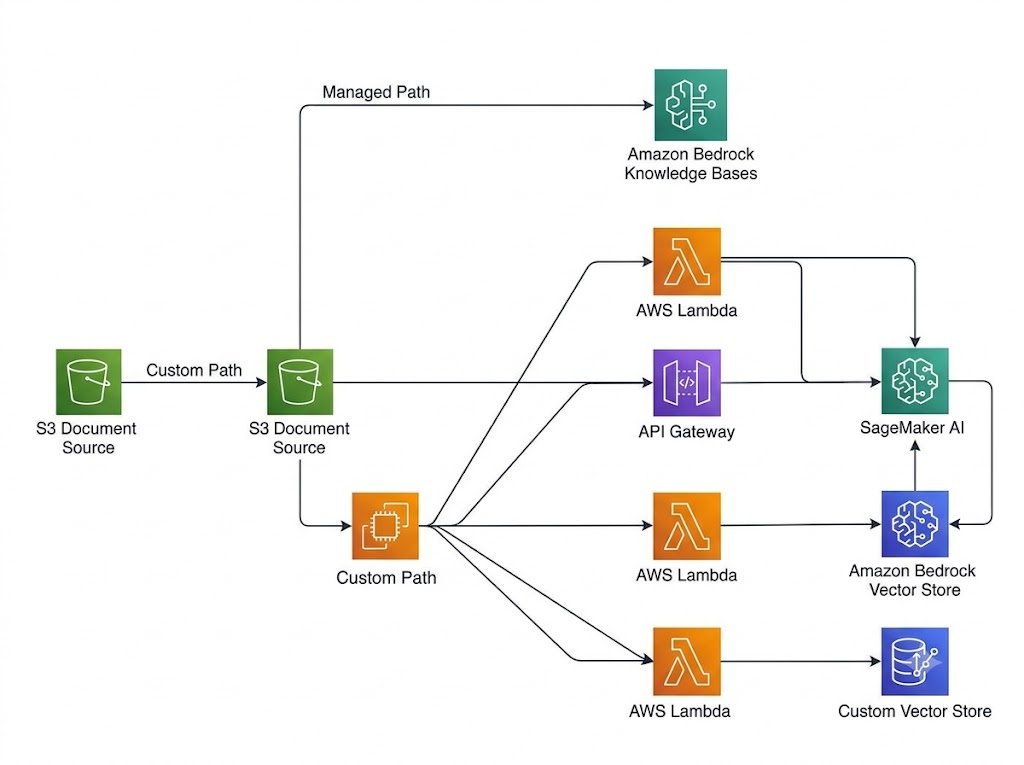
AWS gives you two routes. You can assemble a custom pipeline from primitives, or use a managed service that handles ingestion, chunking, embedding, storage, and retrieval for you. The prescriptive guidance on fully managed RAG options covers the trade-off in depth. Managed services cost less engineering time and give you fewer places to intervene when quality slips.
Amazon S3 as the Document Source
Nearly every RAG architecture on AWS starts with documents in Amazon S3. Event notifications trigger re-indexing when a file changes, which keeps the knowledge base current without a scheduled job.
Amazon Bedrock Knowledge Bases
Amazon Bedrock Knowledge Bases is the managed RAG service. The fully managed version, generally available since June 2026, ships with six native connectors for Amazon S3, SharePoint, Confluence, Google Drive, OneDrive, and a web crawler, plus automatic syncing, Smart Parsing for mixed document formats, and an Agentic Retriever that plans multi-step queries.
The RetrieveAndGenerate API handles the whole loop in a single call. The Retrieve API returns passages only, which suits teams that want to control prompt construction themselves.
Choosing a Vector Store
Bedrock Knowledge Bases supports several backing stores, and the choice drives a large share of the running cost.
|
Vector store |
Billing shape |
Suits |
| Amazon S3 Vectors | Storage and requests | Most new workloads, large corpora |
| Amazon OpenSearch Serverless | Minimum compute units, always on | Existing OpenSearch estates |
| Amazon Aurora PostgreSQL with pgvector | Database instance hours | Teams already running Aurora |
| Amazon OpenSearch managed cluster | Instance hours | Full control over index tuning |
| Pinecone, MongoDB Atlas | Vendor pricing | Existing third-party commitments |
Amazon S3 Vectors reached general availability in December 2025 and offers up to 90% lower vector storage cost than conventional vector databases while supporting very large indexes at sub-second latency. AWS’s own Bedrock RAG sample carries a blunt warning that OpenSearch Serverless bills a minimum of four compute units at all times, which is the single most common source of surprise on a first RAG invoice.
Embedding Models
Amazon Titan Text Embeddings and Cohere Embed are both available through Amazon Bedrock, billed on input tokens only. Switching embedding models later means re-indexing the entire corpus, so this is worth testing properly before the first production sync.
Reranking
A reranker takes the top twenty or so retrieved passages and reorders them by fine-grained relevance before they reach the model. A 2026 survey of production RAG architectures places reranking among the highest-return additions to a pipeline, and it is one of the cheapest to bolt on afterwards. On Bedrock, Amazon Rerank and Cohere Rerank are both billed per query, which keeps the cost predictable as passage counts move around.
Guardrails and Grounding
Amazon Bedrock Guardrails adds contextual grounding checks that compare the generated answer against the retrieved source and flag claims that are unsupported. Sensitive information filters redact personally identifiable data before it reaches a user. For regulated workloads, Automated Reasoning checks validate answers against a formal policy.
Agentic RAG
In standard RAG the system retrieves once and answers. Agentic RAG adds a loop, so the system decides how many retrievals it needs, reformulates the query between attempts, and checks its own work before responding. Amazon Q Business implements this pattern natively, and Amazon Bedrock AgentCore provides the runtime, memory, and observability layer for building your own.
Custom Pipelines
When retrieval logic is itself a product feature, teams build the pipeline directly: AWS Lambda for orchestration, Amazon SageMaker AI for custom embedding or reranking models, and Amazon API Gateway in front. This route costs more engineering time and gives you every knob.
>>> Read more: How to Implement AI Agents on AWS in 2026
What a RAG System Costs on AWS
RAG adds several line items that sit outside foundation model token spend. These are the ones that show up on a Bedrock bill.
|
Component |
How it bills |
| Vector storage | Storage plus requests, or compute units per hour |
| Embedding generation | Input tokens, once per chunk at index time |
| Document parsing | Around $0.010 per page for standard output |
| Reranking | Per query, with a query covering up to 100 document chunks |
| Structured data retrieval | Per generated SQL query |
| Contextual grounding checks | $0.10 per 1,000 text units |
| Generation | Standard input and output token rates |
Embedding and storage costs scale with corpus size. Query costs scale with usage. Those two curves come apart fast, which is how a knowledge base built for a hundred-user pilot ends up billing the same storage whether ten people or ten thousand ever query it.
Current rates live on the Amazon Bedrock pricing page and change often enough to verify before budgeting.
>>> Read more: What Is CUDOS Dashboard Setup Consulting and When Does Your Business Need It?
Common Use Cases for RAG
RAG fits any task where the answer must reflect your private or current information. The list below shows where it delivers the most value.
- Customer support assistants that answer from product manuals and policy documents.
- Internal knowledge bots that help employees find HR, IT, and compliance information.
- Research tools that summarize long reports and cite the source pages.
- Financial assistants that explain products using the latest filings and guidelines.
- Ecommerce search that understands shopper intent through natural language and images.
Renova Cloud has shipped these patterns for regional enterprises. Our work with ACB Securities built SMARTY, a Gen AI investment assistant on Amazon Bedrock. Our RenoSight solution applies Gen AI to retail shelf compliance. These examples show RAG moving from concept to measurable business results.
How to Measure RAG Success

A RAG project needs clear metrics from day one. Track the signals below to judge quality and cost.
- Answer faithfulness, which measures whether the response stays true to the retrieved context.
- Context relevance, which checks that retrieved chunks actually match the question.
- Answer relevance, which checks that the response addresses the user’s need.
- Latency and cost per query, which keep the system practical at scale.
Start with a narrow use case and a small document set. Expand only after the metrics show stable quality. This disciplined approach is the difference between a demo and a system your business can trust.
>>> Read more: Renova Cloud Accelerates Enterprise AI as Anthropic Authorized Reseller in Vietnam
Frequently Asked Questions
What is RAG in AI?
RAG in AI is an architecture that lets a language model consult external documents at response time. It combines information retrieval with generation so the model answers from sources you provide.
Is RAG the same as a chatbot?
A chatbot is a user interface. RAG is the method that powers many modern chatbots by grounding their answers in your data. You can build a RAG system without a chat window, such as a document summarizer.
Do I need to train a model to use RAG?
No training is required to start. RAG works with existing foundation models and connects them to your documents. Training or fine-tuning becomes relevant only when you need a specialized style or task format.
How much data do I need for RAG?
You can begin with a focused set of documents for a single use case. The system scales as you add more sources, so start small and grow with measured results.
Build Your RAG Architecture With Renova Cloud
Renova Cloud is an AWS Premier Tier Partner and three-time AWS Partner of the Year for Vietnam, holding the AWS AI Services Competency and an authorised Anthropic reseller agreement for Claude in the enterprise.
Our engineers work across the full Bedrock stack, from knowledge base architecture and vector store selection through to guardrails, evaluation sets, and cost governance.
We help teams pick the right retrieval architecture for their document set, test chunking and embedding choices against real questions from your own users, and keep the running cost predictable as the corpus grows.
Our Generative AI on AWS practice covers the whole path, from a scoped proof of concept to a supported production platform.
Talk to our AWS and AI team about what RAG could do with your data.