
 Services
  Technologies
  About
About Success




AWS vs Azure vs Google Cloud: 2026 Comparison for Enterprise Decision-Makers in Vietnam
Share article


Table of Contents
Picking a cloud provider in Vietnam used to come down to price and habit. That changed in 2026. A new data protection law took effect in January, AWS opened its first Local Zone inside the country in June, and the AI race between the three providers moved fast enough that last year’s comparison charts are already out of date. Here is where AWS, Azure, and Google Cloud actually stand on market position, infrastructure, AI, pricing, and Vietnam’s compliance rules.
The Cloud Market in 2026: Where AWS, Azure, and Google Cloud Stand
Before weighing features, it helps to see where the three providers stand.
All three are large, stable, and trusted by enterprises worldwide, so the differences that matter are about fit rather than survival. Cloud spending keeps climbing, with AI workloads now the biggest driver of new demand, and that growth has pulled all three providers into a tighter race than they were in a few years ago.
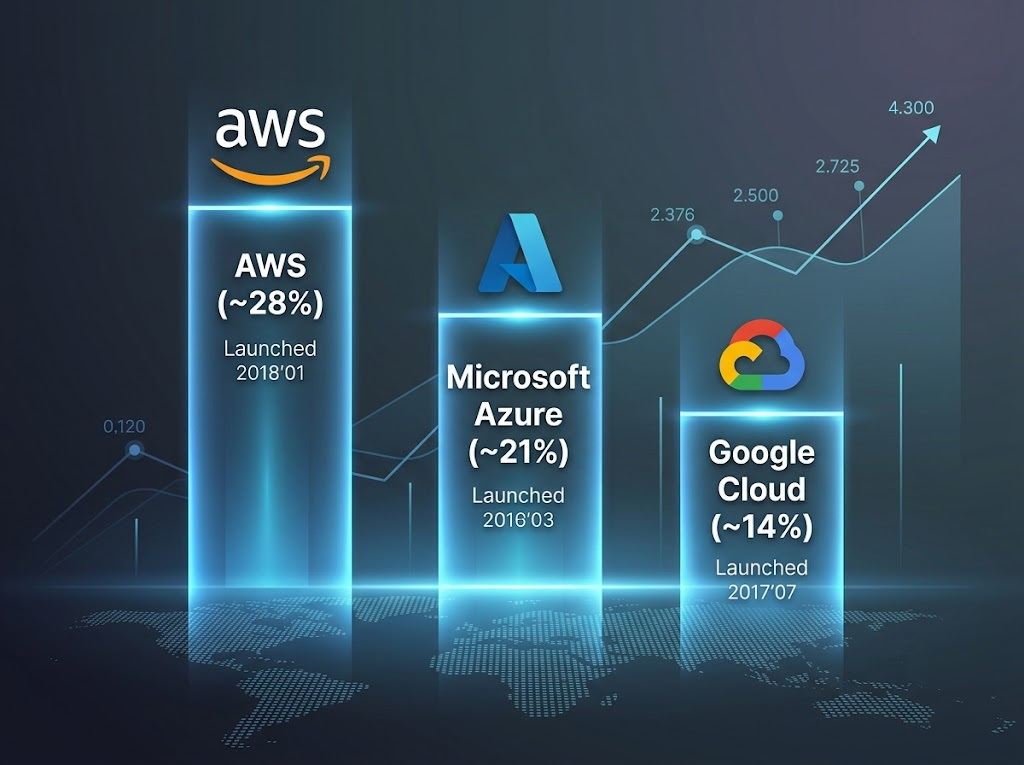
The three sit in a fairly settled order by size.
| Provider | Global market share, Q1 2026* | Launched | Known for |
| AWS | ~28% | 2006 | Broadest service range, mature ecosystem |
| Microsoft Azure | ~21% | 2010 | Microsoft integration, hybrid and enterprise |
| Google Cloud | ~14% | 2008 | Data analytics, AI and machine learning |
*Synergy Research Group estimates, reported via Statista. Figures vary by source and quarter, so treat them as a guide to scale.
AWS Still Leads the Pack
Synergy Research Group data, reported by Statista, puts AWS at 28 percent of the global cloud infrastructure market in the first quarter of 2026, ahead of Azure at 21 percent and Google Cloud at 14 percent. AWS also runs the widest catalog of managed services anywhere, with over 200 products covering compute, storage, networking, and machine learning. For a business hiring in Ho Chi Minh City or Hanoi, that scale translates into a bigger pool of certified engineers and local partners to pull from.
Azure Is Closing the Gap
Azure’s growth tracks closely with Microsoft’s existing footprint inside large organizations. Companies already paying for Microsoft 365 or running Dynamics tend to extend that relationship to Azure rather than start fresh somewhere else. In early 2026, Microsoft folded GPT-5 directly into Azure’s enterprise services, so customers got built-in access to a frontier model without switching vendors. For a Vietnamese company already standardized on SharePoint or Office 365, that single fact can outweigh the market share gap entirely.
Google Cloud Is Smaller but Growing the Fastest
Google Cloud sits in third place by share but posted the strongest percentage growth of the three providers in recent quarters. Its reputation rests on data analytics and machine learning, with BigQuery and Kubernetes Engine widely seen as the most mature tools in their categories. Google also cut compute pricing by roughly 8 percent across regions this year, a direct play for budget-conscious workloads that AWS and Azure have not matched.
AWS vs Azure vs Google Cloud: Strengths Compared

Market share shows which platforms are popular. Whether one fits your particular workloads is a separate question, and usually the more useful one to ask. Each provider has areas where it clearly does better, and matching those to what your business runs day to day is where the decision gets real.
Amazon Web Services
AWS is the broad, mature option that fits almost anything.
- Best for: complex or varied workloads, and teams that want the widest service range and the easiest hiring in Vietnam. With more than 200 services on offer, it rarely lacks a building block for what you are trying to do.
- Strengths: the longest track record (since 2006), the biggest community and partner network, and the most extensive global infrastructure of the three. Its AI stack runs deep, with Amazon Bedrock for access to many foundation models, Amazon SageMaker for custom training and deployment, and custom Trainium and Inferentia chips that cut the cost of training and inference.
- Pricing: strong price-performance on common Amazon EC2 workloads, helped by custom Graviton processors. Savings Plans and Reserved Instances bring the rate down further on steady, predictable workloads.
- Watch out for: the size of the catalog, which can feel overwhelming without someone to guide it, and a pricing model with enough levers that the bill needs active management.
Microsoft Azure
Azure is the natural choice for Microsoft-centric organizations.
- Best for: companies already invested in Microsoft, and hybrid setups that mix on-premises systems with the cloud. Teams running Windows Server, SQL Server, or Microsoft 365 tend to reach value fastest here.
- Strengths: smooth integration with Windows Server, Active Directory (now Microsoft Entra ID), SQL Server, and Microsoft 365, plus strong hybrid management through Azure Arc and Azure Stack. It runs the most regions of the three, which helps with data residency, and offers government and sovereign cloud options for regulated work. For AI, the Azure OpenAI Service brings managed access to leading models.
- Pricing: existing Microsoft licensing agreements, including Enterprise Agreements and Azure Hybrid Benefit, can simplify the commercial side and reuse licenses you already own.
- Watch out for: forecasting the bill, since Azure’s layered pricing and large number of SKUs take real effort to predict.
Google Cloud
Google Cloud is the smallest of the three by revenue, though it grows the fastest.
- Best for: companies that put analytics and machine learning at the center of their plans, and teams that lean on Kubernetes, which Google originally created.
- Strengths: BigQuery for serverless analytics at scale, a strong managed Kubernetes service in Google Kubernetes Engine, and a long machine learning history that shows in Vertex AI, its Gemini models, and custom TPU hardware.
- Pricing: automatic sustained-use discounts, committed-use discounts, and competitive rates on AI workloads, which often make it the cheaper option for heavy data and ML jobs.
- Watch out for: a thinner partner and service footprint in some regions, including fewer local specialists in markets like Vietnam, worth checking before you commit.
Pricing Models and Cost Considerations
Sticker prices across the three platforms sit closer together than most buyers expect. The real cost gaps usually come from architecture choices, data transfer fees, and discount programs more than the hourly rate printed on a virtual machine listing.
| Factor | AWS | Azure | Google Cloud |
| Pricing approach | Pay-as-you-go, Savings Plans, Reserved Instances | Pay-as-you-go, Reserved VM Instances, Hybrid Benefit for Windows | Pay-as-you-go with automatic sustained use discounts |
| General compute cost | Comparable to Azure | Comparable to AWS | Often 5 to 10 percent lower |
| Data egress | Billed per GB leaving the region | Billed per GB leaving the region | Billed per GB, lower for traffic inside Google’s network |
| Best fit for cost control | Long term reserved workloads | Organizations with existing Microsoft licensing | Variable or analytics-heavy workloads |
Egress fees and storage class decisions tend to move a bill more than the headline compute price once a workload runs at real scale. A Well-Architected Review before migration catches most of these cost traps before they ever hit an invoice.
How to Choose Between AWS, Azure, and Google Cloud

No provider wins every situation, so match the platform to your own constraints and goals. Before committing, it helps to run a structured check, such as an AWS Well-Architected Review or a total cost of ownership model, so the decision rests on your real numbers instead of a vendor pitch. A few questions usually point the way for enterprises in Vietnam.
- Already heavy on Microsoft? Azure usually fits best, thanks to licensing and tight integration with tools you already run.
- Want the widest service range and the deepest talent pool in Vietnam? AWS is the common default and the easiest to staff.
- Building around analytics and machine learning? Google Cloud is worth a close look for its data tooling.
- Bound by strict data residency? Favor whichever provider gives you compliant local storage and processing today, which in mid-2026 points strongly toward AWS in Vietnam.
A growing number of enterprises end up using more than one provider, placing each workload where it runs best. That flexibility has a price in complexity, since every extra platform means more tools, more skills, and more governance to manage. For most teams in Vietnam, picking a primary provider and going deep on it returns more value than spreading effort thin across all three.
Choosing the Right Cloud for Your Business Type

Which provider wins really depends on what an organization already runs and where its customers sit.
Startups and Cloud-Native Teams
Early stage companies building from scratch tend to default to AWS for its documentation, its community size, and the sheer number of services available, all of which shorten the ramp-up time for new engineering hires.
Enterprises Running on Microsoft Tools
Organizations with heavy investments in Windows Server, Active Directory, or Microsoft 365 usually find Azure migrations go smoother, since licensing and identity management carry over with far less friction.
Data and Analytics-Driven Organizations
Companies whose value comes mainly from data processing, reporting, or machine learning at scale tend to land on Google Cloud for BigQuery and the rest of its analytics stack.
For most mid-size and enterprise businesses in Vietnam, AWS is still the practical default. It has new infrastructure in Hanoi, the largest partner network in the country, and the most established history with local compliance work.
What Matters Most for Enterprises in Vietnam
The global comparison is only half the story. Running workloads from Vietnam brings in local factors that can outweigh raw feature counts, especially around data rules and where your infrastructure physically sits. For a lot of companies, these are the points that actually decide it.

Data Residency and Local Law
Vietnam’s data rules tightened sharply at the start of 2026. The Personal Data Protection Law took effect on 1 January 2026, and Decree 356/2025/ND-CP set out detailed obligations on consent, data subject rights, and cross-border transfers, including impact assessments that must be filed with the authorities.
The Vietnam Data Law, effective from July 2025, layers storage and transfer requirements on top. For a lot of enterprises, this turns the ability to store and process data inside the country into a deciding factor rather than a nice-to-have.
AWS publishes a Vietnam compliance summary that maps these rules to its services, which is a useful starting point for legal and IT teams.
Local Infrastructure and Latency
Physical presence in the country shapes both compliance and speed. In June 2026, AWS launched its first Local Zone in Hanoi, the first such infrastructure in Vietnam. It supports local storage and backup through Amazon S3 and Amazon EBS Local Snapshots, helping customers meet data residency requirements while keeping single-digit millisecond latency for nearby users.
AWS also runs CloudFront edge locations in Hanoi and Ho Chi Minh City and offers Direct Connect in the country. Azure, Google Cloud, and regional providers are chasing the Vietnamese market as well, so check each provider’s current local footprint against your own latency and residency needs before you decide.
A Local Zone works differently from a full region, and that shapes what you can rely on it for. It extends a parent region rather than standing on its own, so the Hanoi zone is managed from AWS’s Singapore region and runs a focused set of services.
If a workload needs full in-country redundancy across several availability zones, confirm exactly which services each provider runs on Vietnamese soil before counting on it.
Pricing and Cost Control
All three providers use pay-as-you-go pricing with discounts for commitment, and on paper their rates sit close together. The real difference shows up in how predictable your bill stays as you scale.
Azure’s layered pricing can be hard to forecast, AWS rewards careful use of Reserved Instances and Savings Plans, and Google Cloud leans on automatic sustained-use discounts.
Whichever platform you pick, ongoing cloud cost optimization usually moves the final figure more than the headline rate does, which is why FinOps has become a standard practice for cloud-heavy companies.
Talent and Local Partner Support
Whatever you pick, someone has to run it. AWS has the largest skills base and partner community in Vietnam, which makes hiring and outside support easier to arrange.
A local AWS consulting partner can shorten migrations and keep your setup aligned with Vietnamese compliance rules from the start. Once a project gets complex and deadlines tighten, that local knowledge tends to count for more than any single product feature.
Industry Fit for Vietnamese Enterprises
Different sectors lean different ways. Banks, insurers, and other financial firms tend to put compliance, security certifications, and disaster recovery first, which favors providers with proven local controls and audit support.
Manufacturing and retail companies usually care most about scaling for demand peaks and connecting factory or point-of-sale data to analytics. Public sector and state-linked organizations weigh data sovereignty heavily, given the rules above.
Mapping your own sector’s priorities to each provider’s strengths tends to narrow the field faster than any feature-by-feature comparison.
Make the Right Cloud Call with Renova Cloud
Choosing between AWS, Azure, and Google Cloud is easier with a partner who understands both the technology and the local rules.
Renova Cloud, an AWS Premier Partner in Vietnam, helps enterprises plan and run their cloud strategy end to end, from picking the right platform to migrating workloads to AWS and keeping spend under control through FinOps and cost optimization. The team has delivered more than 50 migrations for businesses across manufacturing, finance, and retail, and brings deep knowledge of Vietnam’s data residency and compliance requirements.
Whether you are starting fresh, modernizing legacy systems, or building AI on the cloud, our local experts can guide the decision with you.
Talk to our cloud experts to map out the right approach for your business.