
 Services
  Technologies
  About
About Success



What Are AWS DevOps Services? Complete Guide to Tools, Pipeline & Best Practices
Share article


Table of Contents
Software teams ship faster when their build, test, deployment, and monitoring steps run as one connected flow rather than a series of manual handoffs. AWS DevOps services give engineering teams that connected flow on the world’s largest cloud platform. They combine automation, version control integration, infrastructure provisioning, and observability into a toolchain that supports the full software delivery lifecycle.
This guide explains what AWS DevOps services are, walks through every major tool in the suite, shows how they fit together into a complete CI/CD pipeline, and covers the benefits and real use cases that make them worth adopting. By the end, you will understand the full picture of how DevOps works on Amazon Web Services and where each tool belongs in your workflow.
What Are AWS DevOps Services?
AWS DevOps services are a collection of managed cloud tools that help organizations apply DevOps practices, the combination of cultural philosophies, practices, and tools that increases an organization’s ability to deliver applications and services at high velocity.
Instead of stitching together separate products for source control, builds, releases, and monitoring, teams use AWS services that already integrate with each other and with the broader AWS ecosystem.
The appeal is practical. Software delivery has become a competitive function across nearly every industry, and the numbers reflect that shift. The global DevOps market is projected to grow from around USD 16 billion in 2025 to USD 51 billion by 2031, expanding at a compound annual growth rate above 21 percent.
Adoption has followed the same curve, with more than 78 percent of organizations reporting DevOps practices in place by 2025. AWS DevOps services sit at the center of that demand because they remove the operational burden of running CI/CD infrastructure yourself.
What makes these services distinct is that AWS manages the underlying infrastructure. You define pipelines, build specifications, and deployment rules, and the platform handles scaling, patching, and availability. That frees teams to focus on the application instead of the machinery that delivers it.
The Five Core Principles of AWS DevOps
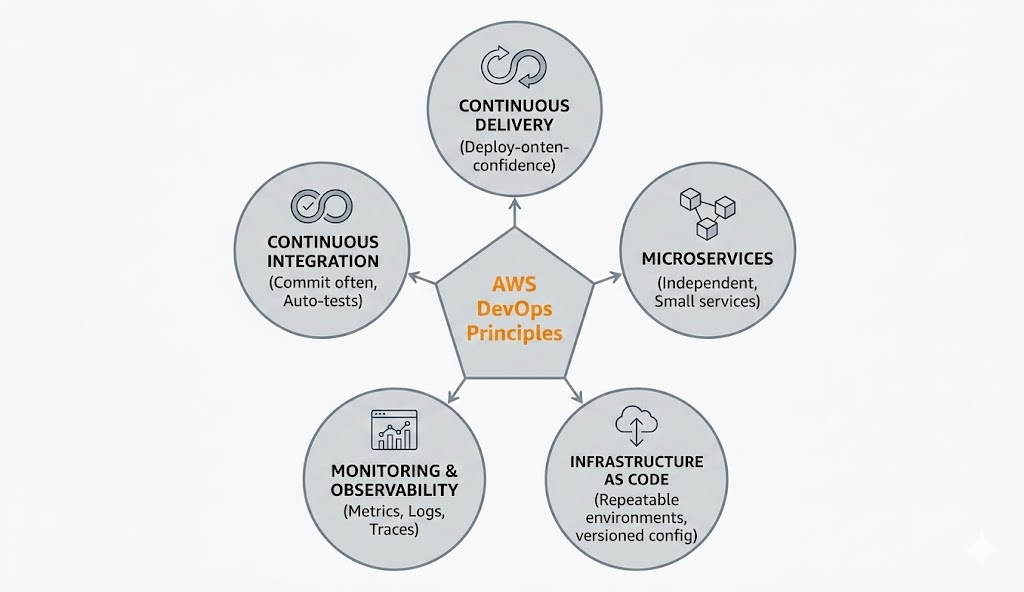
AWS frames its DevOps approach around five practices that shape how the tools are designed and used.
Continuous IntegrationDevelopers merge code changes into a shared repository frequently, and each merge triggers an automated build and test run. This catches integration problems early, while they are small and cheap to fix. |
Continuous DeliveryEvery change that passes the automated test stages is prepared for release to production. Teams can deploy on demand with confidence because the release path has already been validated. |
MicroservicesApplications are built as a set of small, independent services that communicate through well-defined interfaces. Each service can be developed, deployed, and scaled separately, which suits cloud-native delivery. |
Infrastructure as CodeServers, networks, and other resources are defined in configuration files and provisioned through code. This makes environments repeatable and version controlled, and it removes the drift that comes from manual setup. |
Monitoring and ObservabilityTeams capture metrics, logs, and traces from applications and infrastructure so they can understand system behavior, spot anomalies, and respond quickly when something breaks. |
These principles work together. Automation enables speed, infrastructure as code enables consistency, and observability provides the feedback loop that keeps quality high as deployment frequency rises.
The Complete List of AWS DevOps Tools
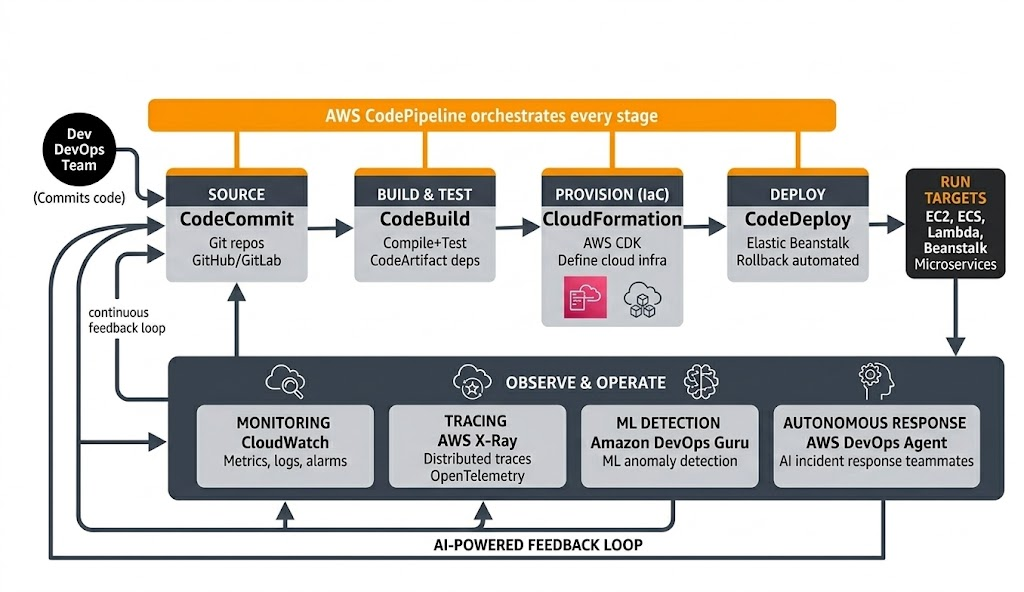
The AWS DevOps suite covers the entire pipeline, from the moment code is committed to the moment it runs in production and beyond. Here is what each tool does and where it fits.
AWS CodePipeline
AWS CodePipeline is the orchestration layer of the suite. It models your release process as a series of stages, source, build, test, deploy, and runs every code change through that sequence automatically. When a developer pushes a commit, CodePipeline moves the change through each stage and stops the moment anything fails. It connects to the other AWS DevOps tools and to third-party services such as GitHub and GitLab, which makes it the backbone that ties a pipeline together.
AWS CodeBuild
AWS CodeBuild is a fully managed build service that compiles source code, runs tests, and produces deployable artifacts. There are no build servers to provision or scale because CodeBuild spins up compute on demand and shuts it down when the job finishes. You define the steps in a build specification file that lives alongside your code, so the build process stays version controlled with everything else.
AWS CodeDeploy
AWS CodeDeploy automates how new application versions reach your compute targets, whether those are Amazon EC2 instances, on-premises servers, AWS Lambda functions, or containers. It supports rolling, blue/green, and canary deployment strategies, which let you release gradually and roll back automatically if health checks fail. This control over the release step reduces the risk that a bad deployment takes down a production system.
AWS CloudFormation
AWS CloudFormation brings infrastructure as code to the suite. You describe your AWS resources in a template using JSON or YAML, and CloudFormation provisions and configures them for you in the correct order. The same template can recreate an identical environment for development, staging, and production, which removes guesswork and manual configuration from infrastructure management.
AWS Cloud Development Kit (CDK)
The AWS CDK lets developers define cloud infrastructure using familiar programming languages such as TypeScript, Python, Java, and Go rather than raw template syntax. The CDK compiles your code into CloudFormation templates behind the scenes, so you get the safety of infrastructure as code with the expressiveness of a real programming language, including loops, conditionals, and reusable components.
Amazon CloudWatch
Amazon CloudWatch is the monitoring and observability service that collects metrics, logs, and events from AWS resources and applications. Teams use it to build dashboards, set alarms that fire when a metric crosses a threshold, and trigger automated responses to operational changes. CloudWatch gives the feedback loop that DevOps depends on, turning raw signals into visibility you can act on.
AWS X-Ray
AWS X-Ray helps developers analyze and debug distributed applications, especially those built on microservices. It traces requests as they travel across services and shows where time is spent and where errors originate. For applications spread across many small components, X-Ray turns a confusing web of calls into a clear map of how a request flows through the system. AWS has been moving X-Ray toward OpenTelemetry as its primary instrumentation standard, aligning it with open observability practices.
AWS Elastic Beanstalk
AWS Elastic Beanstalk is a platform service that handles deployment, capacity provisioning, load balancing, and scaling for web applications. You upload your code, and Elastic Beanstalk manages the underlying infrastructure while still giving you full access to the resources it creates. For teams that want a fast path to a running, production-grade environment without managing every layer themselves, it offers a strong starting point.
Amazon DevOps Guru
Amazon DevOps Guru applies machine learning to operational data to surface issues before they affect users. It analyzes metrics, logs, and application behavior to detect anomalies, identify likely causes, and recommend remediation steps. Rather than waiting for a threshold alarm, DevOps Guru learns what normal looks like for your application and flags deviations that traditional monitoring might miss.
AWS DevOps Agent
The newest addition to the suite, AWS DevOps Agent, was announced at re:Invent 2025 and became generally available on March 31, 2026. It is a generative AI agent that acts as an always-available operations teammate, investigating incidents the way an experienced engineer would. The agent learns your applications and their relationships, then correlates telemetry, code changes, and deployment data across your observability tools, runbooks, code repositories, and CI/CD pipelines to identify probable root causes and recommend fixes.
DevOps Agent works across AWS, multicloud, and on-premises environments, and it integrates with tools such as Amazon CloudWatch, Datadog, GitHub, GitLab, and Slack. During its preview, customers reported 3 to 5 times faster incident resolution, with mean time to resolution dropping from hours to minutes. Its arrival signals where AWS DevOps services are heading, toward autonomous operations that handle the first stage of incident response without constant human oversight.
How a Complete CI/CD Pipeline Works on AWS
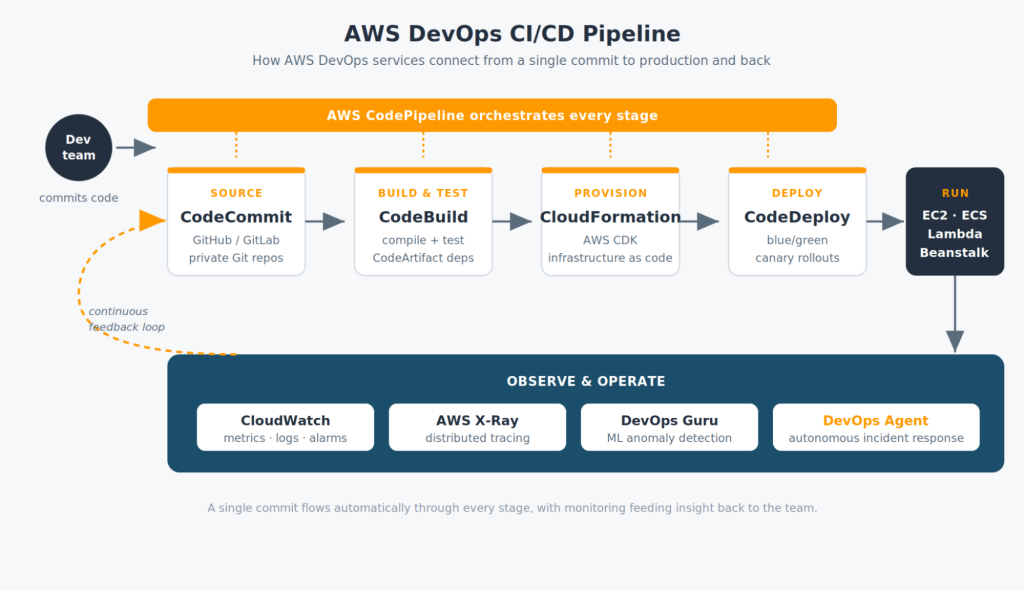
The real value of AWS DevOps services appears when the tools combine into a single automated pipeline.
The flow begins when a developer pushes a commit to a source repository. CodePipeline detects the change and starts the release process. CodeBuild compiles the code, runs the test suite, and packages the result into a deployable artifact. CloudFormation or the CDK provisions or updates the infrastructure that the application needs. CodeDeploy then rolls the new version out to the target environment using a controlled strategy that can roll back automatically if health checks fail.
Once the application is live, CloudWatch collects metrics and logs, X-Ray traces requests across services, and DevOps Guru watches for anomalies. When an incident does occur, DevOps Agent investigates by correlating signals across the entire toolchain. This closed loop, from commitment to production to feedback, is what allows teams to ship many times a day with confidence.
High-performing teams that operate this way deploy code dramatically more often and recover from failures far faster than slower teams, with research pointing to deployment frequencies many times higher and recovery times much shorter.
Benefits of AWS DevOps Services
Adopting AWS DevOps services delivers gains that compound over time.
Faster delivery
Automated pipelines remove manual steps and waiting, so changes move from idea to production in hours rather than weeks. Teams that combine DevOps with agile programs report around 29 percent faster releases.
Higher reliability
Automated testing and controlled deployment strategies catch defects before they reach users, and rollback mechanisms limit the blast radius when something does slip through. Earlier defect detection through continuous testing has been shown to cut quality-related costs by as much as 60 percent.
Scalability on demand
Because AWS manages the underlying infrastructure, your pipelines and applications scale with workload without manual capacity planning.
Lower operational cost
Managed services mean you pay for what you use and avoid the overhead of running build farms and monitoring stacks yourself.
Better security and governance
Infrastructure as code makes environments auditable and repeatable, and integration with AWS identity and access controls keeps permissions tight across the pipeline.
Real-World Use Cases
AWS DevOps services apply across many scenarios.
- Instacart relies on AWS CodeDeploy to manage hundreds of deployments a day, shipping changes to customers quickly and reliably. Automating the release step lets its engineers spend their time building features rather than maintaining servers or coordinating manual rollouts.
- Capital One rebuilt its banking platform around AWS DevOps practices as part of a cloud-first strategy. The company defines its infrastructure with AWS CloudFormation, runs automated CI/CD pipelines, and folds security checks into every release. It has reported cutting the time to build new application infrastructure by more than 99 percent, which freed its teams to focus on customer-facing products.
- Airbnb scaled on AWS from roughly 50,000 listings to more than seven million as the business grew. Along the way it moved from releasing every few weeks to shipping updates many times a day, with AWS CodePipeline and AWS CodeBuild handling builds and releases so the team could add features at the pace its users expected.
- BMW Group built its Unified Configurator Platform on AWS, moving from a monolithic on-premises application to microservices. The team set up a CI/CD pipeline using AWS CodePipeline and ran the services on AWS Lambda and AWS Elastic Beanstalk, with the AWS Well-Architected Framework guiding the design.
- United Airlines, T-Mobile, and Western Governors University are among the first organizations using the new AWS DevOps Agent. Connected to their monitoring stacks, it investigates incidents automatically the moment an alert fires and helps on-call engineers resolve them faster.
Need AWS DevOps Expertise in Vietnam?

Understanding the tools is the first step. Putting them together into a secure, automated pipeline that fits your business takes hands-on experience, and that is where a specialist partner makes the difference.
Renova Cloud is an AWS Premier Tier Services Partner based in Vietnam and the first local partner in the country to earn the AWS DevOps Competency, alongside the AWS Migration Competency.
Our team designs and builds automated CI/CD pipelines, implements infrastructure as code, and operates large-scale workloads on AWS for clients across manufacturing, automotive, finance, and digital sectors. We work as an extension of your team, from initial architecture through ongoing managed operations, so you can adopt AWS DevOps services with confidence and move faster without adding operational risk.
Ready to modernize how your team builds and ships software on AWS?
Talk to our AWS DevOps experts and let us help you turn these tools into a delivery engine that scales with your business.